

I have been fascinated by the United Kingdom since Prince Charles and Lady Diana Married. I love all things British. This is a blog to share Pictures and Ideas about England, Ireland, Scotland, and Wales.
Wednesday, March 1, 2023

Wednesday, February 15, 2023
Skipton Castle in Skipton, North Yorkshire, England.
 |
| Skipton Castle in Yorkshire Based in Skipton, this is a medieval Grade I listed Yorkshire castle built by Robert de Romille, a Norman baron, in 1090. It has been preserved for more than 900 years. |
Skipton Castle is a Grade I Listed medieval castle in Skipton, North Yorkshire, England. It was built in 1090 by Robert de Romille, a Norman baron, and has been preserved for over 931 years.
 |
| A colourised photochrom of Skipton Castle, c.1890 – 1900 |
The castle was originally a motte and bailey castle built in 1090 by Robert de Romille, lord of the multiple estates of Bolton Abbey. Shortly after 1102 Henry I extended Romille's lands to include all of upper Wharfedale and upper Airedale. The earth and wood castle was rebuilt in stone to withstand attacks by the Scots. The cliffs behind the castle, dropping down to Eller Beck, made the castle a perfect defensive structure. The Romille line died out.

In 1310 Edward II granted the castle to Robert Clifford who was appointed Lord Clifford of Skipton and Guardian of Craven. Robert Clifford ordered many improvements to the fortifications, but died in the Battle of Bannockburn in 1314 when the improvements were barely complete. Skipton was raided by the Scots during The Great Raid of 1322, yet the castle, with all its improvements, withstood the attack.

During the English Civil War the castle was the only Royalist stronghold in the north of England until December 1645. After a three-year siege, a surrender was negotiated in 1645 between Oliver Cromwell and the Royalists. Cromwell slighted the castle by ordering the removal of the roofs. Legend has it that during the siege, sheep fleeces were hung over the walls to deaden the impact from the rounds of cannon fire. Sheep fleeces feature in the town's coat of arms. Skipton remained the Cliffords' principal seat until 1676. Lady Anne Clifford (1590–1676) was the last Clifford to own it. After the siege, she ordered repairs and she planted a yew tree in the central courtyard to commemorate its repair after the war.
 |
| The yew tree, now over 9 feet in girth was planted as a sapling in 1659 by Lady Anne Clifford following her restoration of the castle. |
 |
| The courtyard at Skipton Castle |
,%202nd%20Earl%20of%20Thanet%20painted%20by%20William%20Dobson%20(1611%E2%80%931646)%20held%20by%20the%20Abbot%20Hall%20Art%20Gallery.jpg) |
| Portrait of John Tufton (1609–1664), 2nd Earl of Thanet painted by William Dobson (1611–1646) held by the Abbot Hall Art Gallery |
Lady Anne's daughter, Lady Margaret Sackville (1614–1676), married John Tufton, 2nd Earl of Thanet (1609–1664) and the castle was then passed down through the Tufton family, becoming the seat of Lord Hothfield in 1871.
 |
| Lady Anne's Way is a 100-mile hiking route between Skipton and Penrith in Northern England. The trail is punctuated by houses and towers once owned by the Clifford family, but is named after Lady Anne Clifford who renovated and repaired the buildings in the 17th century. The route goes through Grassington, Buckden, Askrigg, Garsdale Head, Kirkby Stephen, Great Ormside, Appleby-in-Westmorland and Penrith. |
Today Skipton Castle is a well-preserved medieval castle and is a tourist attraction and private residence. The castle is the start of the 100-mile Lady Anne's Way long-distance path to Penrith.
Further Reginaldus Flandrensis witnessed a Skipton charter around 1130. "He held an office of trust as Seneschall of Skipton Castle, and we must assume that these lands were given to him at about that time as a reward for his services. They amounted to 1 Knight's fee and 14 carucates, and were held under Skipton Castle for feudal service."
.jpg)
The castle has six drum towers, with a domestic range connecting two towers on the northern side, protected by a precipice overlooking the Eller Beck. The first floor comprises the original kitchen, great hall, withdrawing rooms and the lord's bedchamber. New kitchens, storage and work cellars make up the ground floor. The remaining towers are military in nature and purpose. In the 16th and 17th centuries were added a new entrance staircase (replacing the original drawbridge), a further domestic wing, and larger windows in the original structure. The roof is fully intact. In the centre is a Tudor courtyard, the Conduit Court, which contains a yew tree, reputedly planted by Lady Anne in 1659.

The outer curtain wall encloses the inner wards and subsidiary buildings, including the ruins of a 12th-century chapel. The wall is mainly extant, and is pierced by a twin-towered Norman gatehouse. The east tower of the gatehouse contains a 17th-century shell grotto, one of two remaining grottos from this period. (The other is at Woburn Abbey.)
 |
| The 12th-century chapel of St John the Evangelist |
Sunday, January 15, 2023

Wednesday, January 4, 2023
Pendennis Castle

Pendennis Castle (Cornish: Penn Dinas, meaning "headland fortification") is an artillery fort constructed by Henry VIII near Falmouth, Cornwall, England between 1540 and 1542. It formed part of the King's Device programme to protect against invasion from France and the Holy Roman Empire, and defended the Carrick Roads waterway at the mouth of the River Fal. The original, circular keep and gun platform was expanded at the end of the century to cope with the increasing Spanish threat, with a ring of extensive stone ramparts and bastions built around the older castle. Pendennis saw service during the English Civil War, when it was held by the Royalists, and was only taken by Parliament after a long siege in 1646. It survived the interregnum and Charles II renovated the fortress after his restoration to the throne in 1660.
Monday, January 2, 2023
Augustine Abbey

St Augustine's Abbey was a Benedictine monastery in Canterbury, Kent, England. The abbey was founded in 598 and functioned as a monastery until its dissolution in 1538 during the English Reformation. After the abbey's dissolution, it underwent dismantlement until 1848. Since 1848, part of the site has been used for educational purposes (used as boarding houses and a library by The King's School, Canterbury) and the abbey ruins have been preserved for their historical value.
Wednesday, November 9, 2022
The Canterbury Roman Museum

The Canterbury Roman Museum in Canterbury, Kent, houses a Roman pavement which is a scheduled monument, in the remains of a Roman courtyard house which itself is a grade I listed building. The pavement was discovered after World War II bombing, and has been open to the public since 1946. The museum was established in 1961. It houses many excavated artifacts from Roman Canterbury, including the important late Roman silver hoard known as the Canterbury Treasure, together with reconstructions of the Roman town.
Saturday, September 10, 2022
Elizabeth II (The Great) Obituary

Queen Elizabeth II, the seemingly eternal monarch who became a bright but inscrutable beacon of continuity in the United Kingdom during more than seven decades of rule, died Sept. 8 at Balmoral Castle, her estate in the Scottish Highlands. She was 96.
Her death, of undisclosed causes, was announced by Buckingham Palace.
In her reign, which began in February 1952 after the death of her father, King George VI, Elizabeth served as a constant and reassuring figure in Britain and on the world stage as she helped lead her country through a period of profound shifts in geopolitical power and national identity.

The designs of postage stamps and bank notes changed through the decades, but they all depicted the same, if aging, monarch. The British national anthem now shifts to “God Save the King,” but most Britons have only known the other version, for the queen.

Her son and heir, Charles, summed up the power of her constancy in a rare television documentary aired in 2012 to mark her 60th year as queen. “Perhaps subconsciously,” he said, “people feel encouraged, reassured by something that is always there.”

Her last major constitutional action came on Tuesday, when she accepted the resignation of Prime Minister Boris Johnson and asked his successor, Liz Truss, to form a new government.

In a monarchy dating back to at least the 10th century with King Athelstan, Elizabeth’s reign was the longest. In 2015, she broke a record once thought unassailable, surpassing the 63-year rule of her great-great-grandmother, Queen Victoria. While Victoria retreated from her regal duties after the early death of her husband, Prince Albert

Elizabeth — with her outwardly stern demeanor, iron constitution and abiding handbag — remained fully engaged in her queenly duties for most of her life, and true to a pledge she made on her 21st birthday.
Then a fresh-faced princess on tour with her parents in South Africa, she broadcast to British Empire listeners around the globe: “I declare before you all that my whole life, whether it be long or short, shall be devoted to your service, and the service of our great imperial family to which we all belong.”

The length of that service, measured against that of other leading figures, proved astonishing — coinciding with that of 15 British prime ministers, 14 U.S. presidents and seven popes. As supreme governor of the Church of England, Elizabeth appointed six archbishops of Canterbury.

She also had to navigate shifting public attitudes toward the royal family as the increasingly unfettered media laid bare its troubles. The low point came in 1997 with the death in a car accident of her former daughter-in-law, Princess Diana, and public anger at the queen’s halting response to it.

It was one of few missteps, and the crisis passed: By the time of her Diamond Jubilee in 2012, Queen Elizabeth was the subject of a four-day love fest that included a waterborne procession on the River Thames that rivaled a medieval pageant. Her approval rating stood at 90 percent. At a service at St. Paul’s Cathedral, then-Archbishop Rowan Williams said, “We are marking six decades of living proof that public service is possible, and that it is a place where happiness can be found.”

By the time of her Platinum Jubilee in 2022 marking her 70 years as queen, the national celebration had added another dimension, a shared recognition that the reign was almost over and was of a type that would not be seen again in terms of its length, pomp and place in a changed British society. “While we celebrate the mightiness of Elizabeth II’s allegiance to a life of service, we should also acknowledge that an antiquated version of monarchy must now pass into history,” wrote journalist and royal watcher Tina Brown in her 2022 book, “The Palace Papers.”
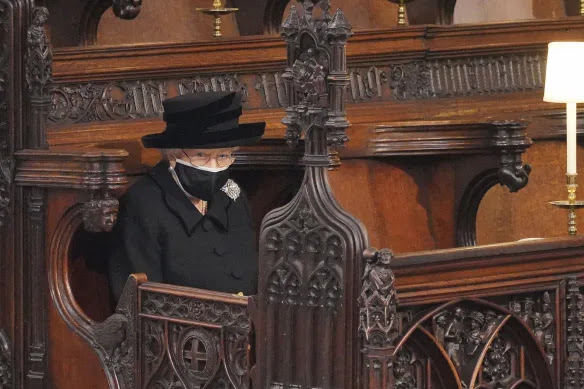
Nothing captured this moment more clearly than the image of the queen at her husband’s funeral, held in 2021 amid restrictions related to the coronavirus pandemic. Dressed in black and with her face veiled by a mask, she seemed alone if not isolated in the oaken pews of St. George’s Chapel, Windsor.
The ensuing months were marked by increasing frailty, a rare hospitalization and a covid infection. She was unable to perform long-standing and familiar public duties.

Into her 90s, she maintained a rigorous calendar of events and appearances. They numbered more than 400 in her Diamond Jubilee year. Her public life was defined by these duties, some seemingly trivial, such as handing out symbolic alms, others mantled with pomp and pageantry — the opening of Parliament or the hosting of a state dinner.
To an outsider, such recurring events might seem perfunctory, but in their recurring character, Charles said, they “help to anchor things” in a dynamic world and, moreover, threaded the monarch through the tapestry of British life.

Her role as queen defined Elizabeth’s life, but her unflagging dedication to the job also defined the monarchy. Unlike her sister and several of her children, including Charles, she kept her personal life intact and avoided private scandal and public controversy. The prospect of abdicating — there were calls for such a move when her great-grandson and third direct heir, Prince George, was born in 2013 — was alien to someone who clung not to power, but to duty.


Dickie Arbiter, a former royal spokesman, said at the time that Elizabeth’s piety alone would prevent it: “She sees herself of having sworn to serve for life not only to the people, but to God.”
The paradox — and possibly the greatest feat — of her reign was her ability to be so visibly dutiful for so long without revealing her inner self. “Of all the world’s public figures, she is the most private,” veteran British journalist Bill Deedes wrote on her 80th birthday.

In his book “The Real Elizabeth,” journalist and historian Andrew Marr wrote, “Her view of her role has been that she is a symbol, and that symbols are better off keeping mostly quiet. The Queen’s style of monarchy has buried much of a sense of self, as we understand that today. ... The Queen is still what she does. There is only a little space (though an interesting space) between Queen Elizabeth II and the woman who lives her life.”

Toward the end of her life, as she cut back her public duties and confronted a series of personal crises, that space seemed ever smaller. In 2020, her grandson Prince Harry essentially defected from the royal family after his marriage to American actress Meghan Markle. In 2021, Elizabeth lost her near-lifelong soul mate Prince Philip after 73 years of marriage, and she had to deal with the fall from grace of her second son, Prince Andrew, accused of sexual misconduct.

And yet for most of her reign, the queen was so deft at subordinating herself to her role that her subjects “actually know much less about the queen than they imagine,” said biographer Robert Lacey in a 2015 interview with The Washington Post. “But it seems to me that’s less important than that people feel they know her very well.”
Were it not for a divorcée from Baltimore, however, the world would hardly have registered a woman known to friends by her childhood nickname of Lilibet.

Elizabeth Alexandra Mary Windsor was born a royal princess on April 21, 1926, at her maternal grandparents’ house in London’s Mayfair district. Her mother, also Elizabeth, was from Scottish aristocracy. Her father, Albert, Duke of York, was the second son of King George V. Princess Elizabeth’s younger sister, Margaret Rose, was born four years later.

The family eventually moved to a mansion on the Windsor estate upriver from London that gave their dynasty its name. As a child, Elizabeth looked set for a genteel life of relative obscurity as a minor royal.

The Duke of York’s older brother, Edward, was in line to succeed their father as king when he died in early 1936. But by then, Edward (called David by his family) was in love with the American socialite Wallis Simpson, whose impending divorce — her second — made her wholly unfit to become his queen in the eyes of the British establishment, including the Church of England.
Edward abdicated — a shocking decision that H.L. Mencken called “the greatest story since the Crucifixion” — and Edward’s brother became King George VI.

Suddenly, at the age of 10, Elizabeth lived with a king for a father and the likelihood that she would be queen one day. She was tutored in British history, and the lives of the monarchs and their fraught relationships with Parliament became less an academic lesson than a map for navigating public life. She was taught to drive a carriage and to ride sidesaddle, a skill needed later on when she reviewed her troops.

During World War II, which ended when she was 19, she conspicuously did not sail to the safety of Canada, as some had advised, but stayed in England and joined the army.
 |
| Princess Elizabeth (third from left) met Prince Philip (standing, second from right) when she was just 13 years old. |
By then, she had found her life’s companion, Prince Philip, also a great-great-grandchild of Queen Victoria and the son of an exiled Greek prince. Philip was making his mark as a young officer in the British navy under the patronage of his uncle Louis Mountbatten.

Their wedding on Nov. 20, 1947, amid postwar reconstruction, provided what Winston Churchill called “a flash of color on the hard road we have to travel.” Now barely remembered, the storybook nuptials between a radiant princess and a dashing blond naval officer foreshadowed the royal weddings of Prince Charles and the former Diana Spencer in 1981 and Prince William and the former Kate Middleton in 2011.

Elizabeth had four children, Prince Charles (1948), Princess Anne (1950), Prince Andrew (1960) and Prince Edward (1964), all of whom survive. She and Philip had anticipated a long reign for George VI and the chance for a fairly normal life as a navy family, but in the winter of 1952, the king died of cancer at 56. Elizabeth accepted her role and fate even if she may have yearned for a wholly different life out of the spotlight.

Then-Princess Elizabeth and her husband were in Kenya and on their way to Australia, taking the place of her ailing father on an official visit, when she learned that the king had died. She flew home as the 25-year-old queen, to be greeted at the airport by a somber phalanx of leaders, including Churchill.

Her crowning the following year provided a much-needed dose of glamour and optimism — about a new Elizabethan Age — in a country suffering from postwar austerity, sharp political and social divisions, the dismantling of its colonial empire and declining global influence.
Her coronation took place in Westminster Abbey on June 2, 1953 — the day that word reached London that mountaineer Edmund Hillary of New Zealand had placed a Union Jack atop Mount Everest in a British-led expedition.

For more than 400 years, the English sovereign has had to navigate the role of being head of state while ceding political power to Parliament and maintaining strict partisan neutrality. By dint of her longevity and diligence, however, Elizabeth had a significant behind-the-scenes advisory role to a succession of prime ministers who traveled each Tuesday from Downing Street to Buckingham Palace to see her.
In those sessions, she offered the political leader of the day confidential advice from her unique perspective of national life and knowledge of foreign leaders and diplomats. Whether the prime ministers took her counsel may have been another matter — the sessions were as private as conversations in a confessional.

At first, her influence was limited by her lack of experience: Churchill was by 1952 an old lion who still spoke fondly of Queen Victoria. But with the passing years, Elizabeth saw prime ministers come and go, and could offer a long-term view enriched by a fierce memory for names and events. “The boot is on the other foot,” Prince Charles said in the 2012 BBC documentary. After so long, “it’s the queen who has Sir Winston’s span of experience.”

In general, Elizabeth was known to have clicked more with some prime ministers than others. In the early 1970s, Edward Heath “treated her as a piece of necessary business,” wrote an Elizabeth biographer, Ben Pimlott. Worse, the pro-European Heath was openly antagonistic to Commonwealth interests and once blocked her from attending a conference of leaders in Singapore.

As the monarch of the Commonwealth of 15 realms and more than 50 nations, Elizabeth kept Britain closely linked to its former territories. In 1999, Australians rejected a referendum to become a republic in a vote seen as reflecting a loyalty to Elizabeth rather than the U.K.

Much was made of the supposed chilly relationship between Elizabeth and Margaret Thatcher, who denied any undue friction. The Iron Lady’s grandiose manner made for an awkward pairing, Pimlott argued. Thatcher would sit tensely on the edge of her seat, which in itself unsettled the queen. “Audiences ceased to be intimate occasions, and became brisk, formal ones,” he wrote.
Two of Thatcher’s predecessors, Anthony Eden and Harold Wilson, found a form of therapy in the sessions, and drew them out.

“Wilson was most enthused about his royal audiences as he came to feel besieged by ministers from left- and right-wing factions,” wrote Marr, the journalist and historian.

As a wife and mother, Elizabeth guarded her privacy with ferocity.
There were times when Prince Philip’s will clashed with the wishes of the prevailing political leaders. Given Philip’s take-charge persona, those episodes led to some of the queen’s most trying times, according to biographers.
Philip balked at moving to the cavernous and court-dominated Buckingham Palace but was overruled. When his uncle smugly announced after the king’s death that the House of Windsor would become the House of Mountbatten, the name change was swiftly put down by Churchill, to Philip’s humiliation.

“I’m nothing but a bloody amoeba,” he complained. In 1960, to Elizabeth’s relief, the government agreed to allow her descendants to use the surname Mountbatten-Windsor.
Despite Philip’s subordination — against type — the marriage was solid and happy, and the prince sometimes referred endearingly to his wife as “Sausage.” The queen’s opening of her speeches with “My husband and I ... ” became a catchphrase. Courtiers who saw them at close quarters observed “a reserved, yet visible, fondness,” Pimlott wrote.

As if to compensate for her official preeminence, Elizabeth deferred to Philip in the upbringing of their children, a strategy that wrought its own effects, especially with the heir.

Philip decided to send Charles to his alma mater, Gordonstoun, a boarding school on the frigid coast of Scotland renowned for its commitment to building character through rigor and privation.
Charles, in middle age, complained of a childhood made unhappy by his mother’s remoteness and father’s authority. His mother remained silent, in public at least, bolstering her image as a hands-off parent and a person who heartily disliked confrontation.

The queen spent the autumn of her life coming to terms with family scandals but also with a media hunger for them unknown when she was a young queen.

Although the queen was said to have adored her younger sister, Margaret, it is hard to imagine two more different siblings, or the state of the monarchy had Margaret been born first. Well before her marriage ended in divorce, Margaret was known as a princess who liked the high life, and who disdained official duty but insisted on royal treatment. Margaret died in 2002.

Margaret’s scandals presaged those of the queen’s children, and the fairy-tale marriage of Charles and Diana turned into the soap opera of the century. Amid public recriminations and revelations of infidelity, the Prince and Princess of Wales formally split in 1992 and, at the queen’s insistence, divorced in 1996. Elizabeth faced other trials in 1992: the divorce of Princess Anne; the separation of Prince Andrew from his wife, Sarah; the release of embarrassing taped phone conversations involving Charles and Diana; and a devastating fire at the queen’s beloved Windsor Castle.
“It has turned out,” she said at a formal luncheon, “to be an annus horribilis.”
Lacey, in his biography of the queen, noted that “she had to use Latin to do it, but for the first time in 40 years, Elizabeth II had given public voice to some genuine pain and vulnerability.”

Not quite five years later, she faced the most severe test of her monarchy. After Diana and her boyfriend died in Paris as their car raced away from the paparazzi, Britons were overcome with a collective grief and rage that turned toward Charles and his family. Elizabeth remained at Balmoral Castle, feeling that her first duty was to isolate her young grandsons from the mounting hysteria.

The anger became focused on the flagpole above Buckingham Palace. The crowd outside wanted to see a flag at half-staff. For the queen, that would have been a breach of protocol and tradition — the palace flagpole was there to fly the royal standard only when the monarch was in residence.
“In the strange symbiosis between ruler and ruled, the people were insisting that the Queen acknowledge that she ruled by their consent, and bend to their insistence,” Tony Blair, prime minister at the time, wrote in his memoir. “Public anger was turning towards the royal family.”

The episode was a rare reminder that for all its history and presence in the fabric and psyche of British life, the monarchy is a fragile institution.

The episode was a rare reminder that for all its history and presence in the fabric and psyche of British life, the monarchy is a fragile institution.
Wallis Simpson, the woman whose fate altered Elizabeth’s destiny, wrote of being unprepared for Edward’s abrupt rejection by an establishment that had put him on a pedestal. “Nothing that I had seen had made me appreciate how vulnerable the King really was, how little power he could actually command,” she wrote.
While Edward put his personal interests ahead of the monarchy, his niece Elizabeth dedicated her life to putting the monarchy first.

Pimlott wrote that “in her reserve there was a vein of sadness: some claimed to see beneath the surface a hint of passion, though for who or what it was impossible to tell. Yet she remained self-sufficient, and did not lose her grip.”

Biographers who probed Elizabeth’s life found that in private, and in unguarded surroundings, she was an excellent mimic, saw thrift as a virtue and enjoyed rather tame and old-fashioned amusements, such as square dancing, jigsaw puzzles, photography and watching television.

She owned a horse racing stable and stud farms, engaged a racing manager to work with trainers, and was actively involved in buying thoroughbreds. In 2013, six decades after her coronation, she watched as her horse Estimate won the Gold Cup at Ascot and reacted with unalloyed joy, beaming and clapping her hands with childlike glee.

On the occasions when her safety was threatened, she showed her mettle. As she rode to Trooping the Colour, the annual ceremonial review of troops, in June 1981, a youth fired six blanks her way. Elizabeth calmed her startled horse and continued on as a Scots guard tackled the youth.

The next year brought an even more chilling threat. In July 1982, a stalker named Michael Fagan found his way into the queen’s bedroom. Her efforts to summon help failed, at least initially. Elizabeth later recalled, according to Lacey, that “I got out of bed, put on my dressing gown and slippers, drew myself up to my full regal height, pointed to the door and said, ‘Get out’ — and he didn’t.”

She was a creature of habit and seemed inherently fastidious. She followed a calendar that changed little over the years. She resided, variously, at Buckingham Palace or her preferred Windsor Castle, where she spent April and most weekends. She decamped to Windsor permanently at the start of the covid-19 pandemic.
She spent most of August and September at Balmoral, where guests were treated to a barbecue run by Philip. “The royals cook, and serve the guests,” recounted Tony Blair. “The Queen asks if you’ve finished, she stacks the plates up and goes off to the sink” to wash them.

For Christmas and the New Year, she reigned over her family at Sandringham, her estate in East Anglia. Perhaps her favorite getaway, a blue-hulled ship named the Royal Yacht Britannia, was retired in 1997 at an event where the queen was seen to shed a rare public tear.
At Balmoral and Sandringham, the public got glimpses of how Elizabeth might have lived had she not become queen: as a well-heeled English countrywoman in green wellies leading a gaggle of muddy Welsh corgis.

She had a small and discreet circle of friends and relatives with whom she could decompress from so public a life, but even they would curtsy in greeting to her, and she maintained a certain distance, according to her biographer Sally Bedell Smith.
Smith, in an interview, said she came to understand Elizabeth by delving into her Sunday morning routines. Elizabeth would worship at the Royal Chapel at Windsor and then drive herself to see her cousin and lifelong friend, Margaret Rhodes, who lived in a cozy cottage on the Windsor estate that the monarch had given her.
Elizabeth would sit on a comfortable but faded sofa, sip her favorite cocktail of gin and Dubonnet, and chat with her cousin about the week’s events amid framed photos of family.

In a rare reflective mood during an address to the Commonwealth leaders in 2011 in Perth, Australia, Elizabeth summoned an Aboriginal proverb to express her feelings.
“We are all visitors to this time, this place. Our purpose here is to observe, to learn, to grow, to love ... and then we return home.”

The latest: Queen Elizabeth II, Britain’s longest reigning monarch, died in Scotland on Thursday. She was 96. Follow our live coverage as the royal family takes on new titles with the new king, Charles III, echoing his mother’s pledge of service in his first speech to the nation.
Operation London Bridge: Britain also has a new queen consort, Camilla, and line of succession that the queen had been planning for some time. This is the plan for after the queen’s death.
A new face: Queen Elizabeth II’s is displayed throughout Britain, looming large on buildings or subtly present on coins inside pockets. Britons will need to swiftly adjust to seeing the face of the new monarch. Here are some of the staples of daily British life that will need to change.
Subscribe to:
Posts (Atom)